The construction and placement of transects are defined as follows (see p. 16575 in
We define 15 equally spaced transects between the source and the end of the rectangular mask for calculating the source rates. We ignore the first three transects due to their close proximity to the source, where may be underestimated due to partial pixel enhancement. To avoid underestimation of emissions due to incomplete sampling of the plume by a transect due to missing pixels, we only consider transects that have more than 75% overlap with
Each transect represents a two dimensional surface intersecting the plume and is composed of pixel scale box models. For each transect, the
Transect validity
The definition of transect validity may be formulated either in terms of the number of pixels intersecting the transect or the number of valid pixel intersections. In practice, for the cases examined here, these two criteria yield equivalent results. However, the definition of what constitutes a valid pixel requires additional consideration and is somewhat more nuanced.
In this work, a pixel is considered valid if its
In addition, we propose an explicit validity criterion that may or may not have been applied in the original implementation but is logically required for meaningful calculations: each transect must include at least one pixel with a methane concentration exceeding the estimated background value .
Using
Transect enhancement calculation
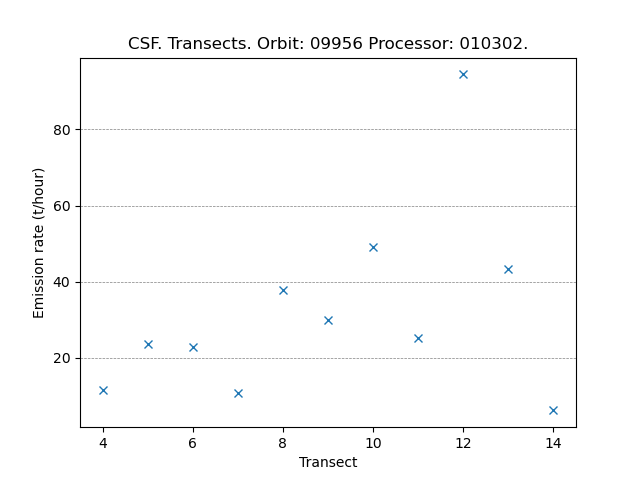
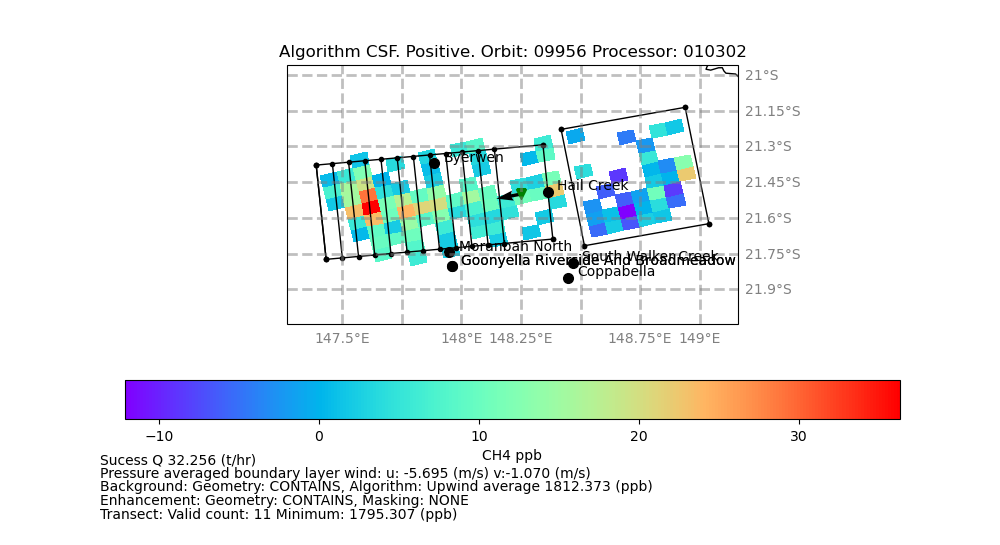
By defining 15 transects across the downwind box, the algorithm constructs 15 cross sectional surfaces intersecting the plume, each composed of pixel scale box models that represent emissions transported at different times. The first three transects are excluded from further analysis, while the remaining twelve are retained. For each of these transects, the pixel level contributions are summed to obtain transect specific emission estimates, which are then averaged across the valid transects to derive a single emission rate for the source.
The results of the transect based emission calculations for orbit 09956 are summarised in Table 13. The Id column indicates that the first three transects were excluded from the analysis. Transect 15 was also rejected because it does not intersect a sufficient number of positive enhancement pixels.
| Id | Valid | Enhancement | Plume width | Positive pixel count | Q |
|---|---|---|---|---|---|
| 4 | True | 0.560 | 22097.327 | 5 | 11.644 |
| 5 | True | 1.138 | 34066.129 | 8 | 23.658 |
| 6 | True | 1.096 | 22418.543 | 5 | 22.778 |
| 7 | True | 0.514 | 19750.431 | 5 | 10.680 |
| 8 | True | 1.819 | 37276.487 | 8 | 37.810 |
| 9 | True | 1.435 | 21553.540 | 5 | 29.821 |
| 10 | True | 2.363 | 35744.508 | 7 | 49.116 |
| 11 | True | 1.216 | 34069.936 | 7 | 25.273 |
| 12 | True | 4.544 | 43910.525 | 9 | 94.435 |
| 13 | True | 2.089 | 33799.922 | 6 | 43.410 |
| 14 | True | 0.298 | 16900.092 | 3 | 6.193 |
| 15 | False | 0.0 | 0 | 0 | 0.0 |
The mean hourly emission rate averaged over the valid transects is 32.256